

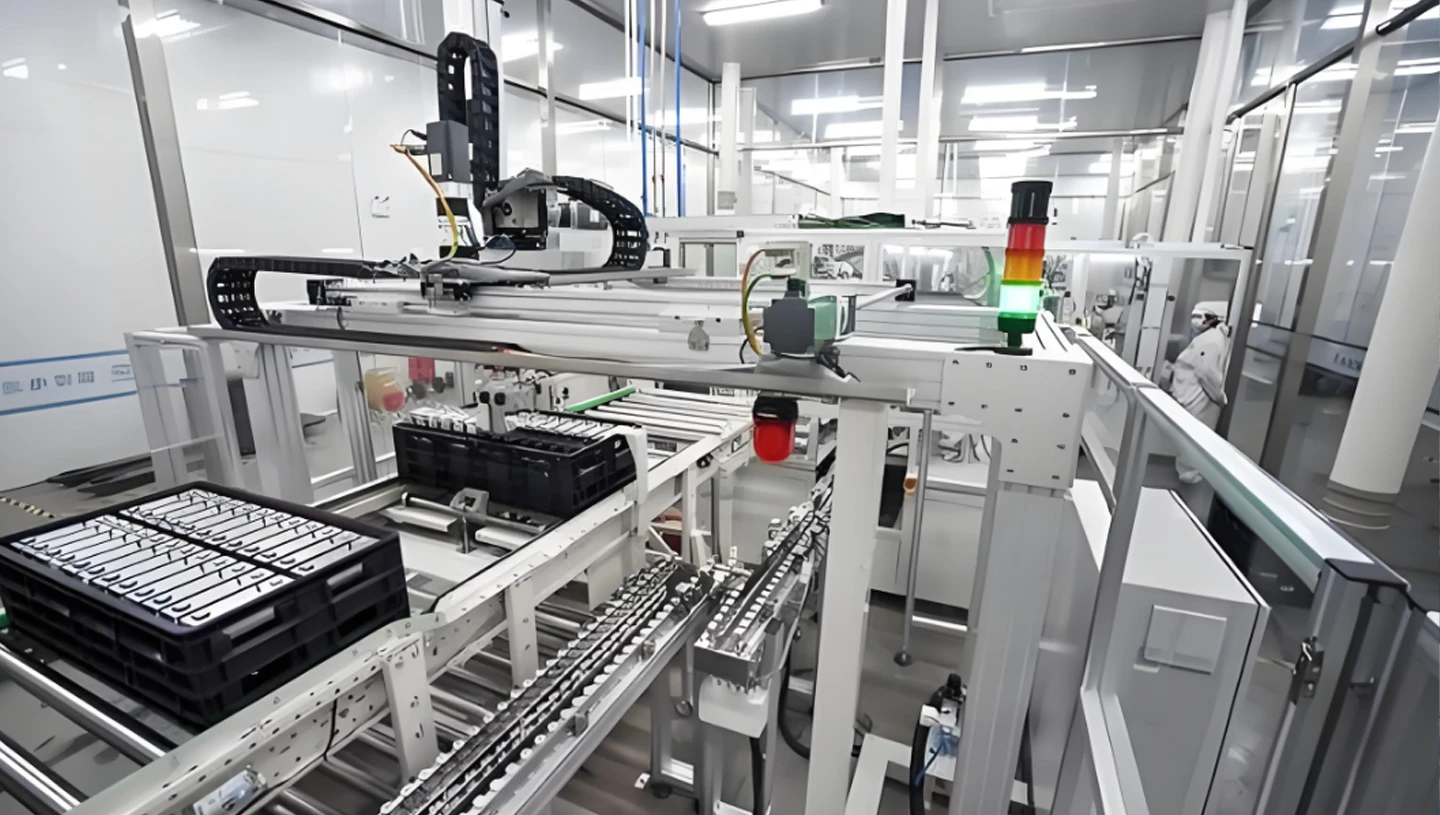
Battery pack assembly is the stage where individual cells become a functional energy storage product. A pack combines cells, module frames, busbars, sensing harnesses, a battery management system (BMS), thermal management, electrical protection, and an enclosure that must survive vibration, temperature cycling, and water exposure. Cell quality sets the upper limit on pack performance, but battery pack assembly determines whether that limit is reached consistently across every unit.
Pack assembly lines differ by cell format and application. Pouch packs emphasize compression control and tab welding; cylindrical packs involve hundreds or thousands of small cells and highly automated welding; prismatic packs use fewer, larger cells with bolted or welded busbars. The line must also support the shift toward cell-to-pack and cell-to-chassis architectures, which reduce or eliminate module steps but place higher demands on cell consistency and pack-level automation.
Battery Pack Assembly Starts with Cell Sorting and Matching
Cell sorting is the first quality gate in battery pack assembly. Every incoming cell is tested for open-circuit voltage, internal resistance, capacity, self-discharge, and dimensional conformity. Cells are then grouped into bins and matched so that the cells in a module or pack have similar electrical characteristics. Without this step, the weakest cell limits usable capacity, the BMS has to work harder to balance the pack, and local heating accelerates aging.
Typical production tolerances are tight. Capacity may be matched within 1 to 2 percent, internal resistance within 5 to 10 percent, and open-circuit voltage within 5 to 10 millivolts. Self-discharge is often screened through a K-value test, which measures voltage decay over a defined storage period. The exact limits depend on cell chemistry, format, and customer specification, but the principle is universal: the more cells in series or parallel, the more important matching becomes.
Traceability is part of the same checkpoint. Each cell serial number should be linked to its test data, material lot, and the pack into which it is installed; the upstream inspection framework in the guide to battery quality control defines the cell-level data that pack assembly needs. If a pack fails end-of-line testing or a field issue appears, the manufacturer can trace the affected cells and contain the problem without recalling every pack produced in the same period.
Module Assembly in Battery Pack Assembly: Welding, Bonding, and Busbars
Module assembly converts sorted cells into a mechanically and electrically stable subassembly. The process includes cell loading into holders or frames, busbar placement, tab or terminal welding, sensing harness installation, thermal interface application, and dimensional inspection. The joining method is one of the most important decisions in battery pack assembly because it determines contact resistance, heat input, mechanical strength, and serviceability.
Laser Welding
Laser welding offers high speed, precise energy delivery, and a narrow heat-affected zone. It is widely used for aluminum and copper busbars, prismatic cell terminals, and cylindrical cell interconnects. The process requires consistent part fit-up, clamping, and gap control, because a small gap can cause incomplete penetration or spatter. Copper is highly reflective at infrared wavelengths, so green or blue laser sources are increasingly used for copper welding to improve absorption and process stability.
Ultrasonic Welding
Ultrasonic welding is a solid-state process that joins foils and tabs through high-frequency mechanical vibration. It produces little heat, avoids melting, and is well suited to pouch cell tabs and thin aluminum or copper conductors. Tooling wear, surface cleanliness, and anvil rigidity are critical to weld quality. Ultrasonic welding is less suited to thick busbars and complex three-dimensional joints than laser welding, but it remains a robust choice for foil-to-tab connections.
Bonding and Bolted Connections
Structural adhesives and thermal adhesives are used to fix cells, attach cold plates, and distribute mechanical loads. Dispensing accuracy, cure schedule, and surface preparation determine bond strength and thermal resistance. Bolted busbar connections are common in packs that require service access or replaceable modules; torque control, contact surface preparation, and anti-loosening features are essential. Every joint should be inspected by resistance measurement, pull testing, cross-sectioning, or vision systems depending on the joining method.
Pouch, cylindrical, and prismatic packs place different demands on this stage. Pouch cells require controlled compression and precise tab alignment; cylindrical cells require automated cell loading and high-speed welding of many small joints; prismatic cells require attention to terminal flatness, busbar fit, and torque or weld quality on larger connection areas.
BMS Integration and Testing in Battery Pack Assembly
The BMS is the control and safety layer of the pack. It monitors cell voltages and temperatures, estimates state of charge and state of health, balances cells, controls contactors, and communicates with the vehicle or energy management system. Battery pack assembly must integrate the BMS harness, voltage sense lines, temperature sensors, connectors, and communication buses without introducing wiring errors, strain, or electromagnetic interference.
Harness installation is a common source of defects. Each voltage sense line must connect to the correct cell or module tap, temperature sensors must be positioned at the intended locations, and connectors must be fully latched. Automated continuity and pin-mapping tests catch wiring errors before power-up. BMS calibration verifies voltage measurement accuracy, temperature accuracy, balancing current, isolation monitoring, and communication functions.
Functional testing should include contactor and precharge sequences, insulation monitoring, overvoltage and undervoltage protection, overtemperature response, and fault-code reporting. For automotive packs, the development process may follow ISO 26262 functional safety requirements, with ASIL classification determined by the vehicle application. EMC testing confirms that the BMS and power electronics do not interfere with other vehicle systems.
Thermal Management Installation in Battery Pack Assembly
Thermal management determines whether the pack can sustain fast charging, high-power discharge, and operation in extreme climates. Air cooling is simple but limited; liquid cold plates provide higher heat transfer and are common in electric vehicles and high-power stationary systems. Immersion cooling is emerging for high-power applications but requires different enclosure and fluid-handling designs.
During battery pack assembly, the cold plate is mounted, thermal interface material is applied, and modules are compressed against the cooling surface. Gap pads, thermal grease, and dispensable gap fillers must be applied at the specified thickness and coverage; too little material leaves air gaps, while too much material increases thermal resistance and mechanical stress. Coolant connections are then assembled and tested for leaks, flow rate, and pressure drop.
Heating may be provided by a positive temperature coefficient heater, heater film, or the thermal management system itself. Thermal runaway propagation requirements also influence pack design: barriers, vent paths, and spacing between cells must be validated at the pack level, not only at the cell level. The assembly line must therefore preserve the intended clearances and avoid damaging the thermal barrier materials during module installation.
Pack Enclosure and IP-Rated Sealing in Battery Pack Assembly
The enclosure protects the pack from water, dust, vibration, and mechanical damage. Aluminum and steel enclosures are common for automotive packs, while composite and sheet-metal designs are used in stationary storage and industrial applications. Gaskets, sealants, and compression limits must be controlled during battery pack assembly to achieve the specified ingress protection rating.
IP67 requires dust-tight construction and immersion in water under defined conditions; IP68 requires a manufacturer-defined deeper or longer immersion test. Sealing performance depends on flange flatness, gasket compression, fastener torque, and surface cleanliness. Venting components equalize pressure during temperature cycling while restricting water ingress. Leak testing may use air pressure decay, helium mass spectrometry, or a combination of methods, followed by a sample-based water immersion or spray test.
High-voltage safety is part of the same enclosure stage. Service disconnect devices, fuses, contactors, precharge resistors, and high-voltage interlock loops must be installed and verified. Equipotential bonding and insulation distances must meet the applicable standard, and all fasteners that carry current or establish grounding must be controlled for torque and contact resistance.
End-of-Line Testing in Battery Pack Assembly
End-of-line testing is the final verification that the pack meets its electrical, thermal, sealing, and functional requirements. A typical test sequence includes insulation resistance, dielectric withstand, equipotential bonding, BMS communication, voltage and temperature accuracy, contactor and precharge function, current sensor verification, coolant leak and flow checks, and a low-rate charge or discharge test.
Insulation resistance is a critical safety parameter. Many electric vehicle standards require at least 100 ohms per volt of working voltage, and some OEM specifications require 500 ohms per volt or more. Dielectric withstand testing verifies isolation between high-voltage circuits and the enclosure, while equipotential bonding testing confirms that exposed conductive parts are connected to the intended ground path.
Pack-level validation also includes standards and homologation testing. UN 38.3 covers transport safety, IEC 62619 covers industrial battery safety, UL 2580 and UL 1973 address electric vehicle and stationary storage applications, GB 38031 and GB/T 31467 define Chinese electric vehicle battery requirements, and UN ECE R100 covers electric power train safety for vehicle approval. These tests are performed on representative samples, while the production line verifies that every pack matches the validated configuration.
Conclusion: Battery Pack Assembly Design for Manufacturability
Battery pack assembly is a systems engineering problem, not simply a sequence of welding and bolting stations. Cell sorting, joining method, BMS integration, thermal management, enclosure sealing, and end-of-line testing all interact. A pack that performs well as a prototype can fail in production if tolerances stack up, if a weld process is sensitive to part fit-up, or if the enclosure sealing process depends on operator skill.
Design for manufacturability should begin before the pack design is frozen. Standardizing fasteners, connectors, busbar geometries, and test interfaces reduces part count and automation complexity. Tolerance analysis should confirm that cell dimensions, module frames, cold plates, and enclosure flanges can be assembled without excessive rework. Service access, fault isolation, and end-of-line diagnostics should be designed into the pack rather than added later.
The trend toward cell-to-pack and cell-to-chassis architectures removes some module steps, but it does not remove the need for disciplined battery pack assembly. It shifts more responsibility to cell consistency, pack-level thermal design, and automated inspection. TOBGROUP supports pack assembly and battery production solutions and can document line configurations in completed production line projects for pouch, cylindrical, and prismatic pack designs.


